She Walked Onstage and I Finally Understood What I Was Waiting For
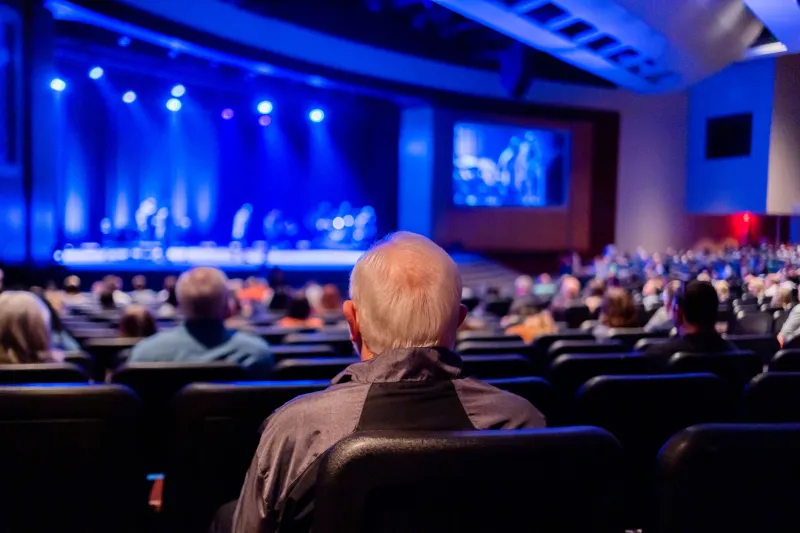
I was twenty-six, sitting in the third row of a mid-sized theater in Chicago, holding a lukewarm coffee I'd grabbed from the lobby because I didn't know what else to do with my hands. The performer onstage wasn't famous. She wasn't on television. She was just a woman with a microphone and a story, and she was completely, unapologetically alive up there.
I don't remember every word she said. What I remember is the feeling — that strange, chest-tightening sensation when something outside of you names something inside of you that you hadn't found language for yet.
By the time she took her bow, I wasn't clapping for her. I mean, I was. But I was also, for the first time in my adult life, clapping for myself.
The Dangerous Comfort of Being a Witness
There's a version of admiration that keeps you safe. You sit in the audience, you consume, you appreciate, and you go home. You tell your friends about this incredible thing you saw. You follow the person on Instagram. You become a loyal, devoted observer of someone else's creative life.
And none of that is bad. Audiences are sacred. Being moved by art is one of the most human things we do.
But there's a shadow side to admiration that doesn't get talked about enough — the way it can quietly convince you that the stage belongs to other people. The way watching brilliance can feel like evidence of your own inadequacy rather than proof that the thing you love is actually possible.
I spent years in that shadow. Watching performers, writers, storytellers. Taking mental notes. Thinking someday and maybe and if only I had what they have. I was fluent in other people's dreams and completely illiterate in my own.
What Changed in That Theater
Here's the thing about the woman I watched that night: she wasn't perfect. She stumbled over a line near the end. She laughed at herself when she did, and the audience laughed with her, and somehow that made everything she said feel more true, not less.
That's what cracked something open in me.
I had built up this idea in my head that the people who got to perform, who got to create and share and stand in front of rooms full of strangers — that they had some quality I lacked. Some innate confidence or talent or permission that had been handed to them and withheld from me.
But watching her fumble and recover, watching her be fully human up there and still hold the room completely, I realized I had been waiting for the wrong thing. I wasn't waiting for talent or opportunity or the right moment. I was waiting for proof that imperfect people were allowed.
She was my proof.
Admiration as a Mirror, Not a Window
Psychologists talk about something called "inspiration" versus "comparison," and the difference between the two is more about mindset than circumstance. When you see someone doing something extraordinary and feel energized, that's inspiration — your brain registering possibility. When you see the same thing and feel smaller, that's comparison — your brain processing threat.
The wild part? The same moment can trigger both responses depending on where you are emotionally. I've watched performers and felt lit up. I've watched different performers — sometimes doing less impressive work — and felt completely deflated.
What I've learned, slowly and not without resistance, is that the deflation is information. It usually means I'm closer to wanting something than I'm willing to admit. The sting of comparison is almost always the sting of desire in disguise.
That night in Chicago, I felt both things in rapid succession. First the familiar shrinking — she's so good, I could never. And then something shifted. Maybe it was the stumbled line. Maybe it was the coffee finally kicking in. But the comparison dissolved into something cleaner: she did it, which means it's a thing that can be done.
Giving Yourself Permission by Proxy
I think a lot of us need to see it happen for someone else before we believe it can happen for us. That's not weakness — that's just how human beings learn. We are wired to watch, to model, to extrapolate. Children learn to walk by watching people walk. We learn to tell stories by hearing stories told.
So maybe the audiences we sit in aren't detours from our creative lives. Maybe they're part of the training.
Every show I attended before I ever performed, every open mic I watched from the back of the room, every storytelling event I attended as a nervous audience member — that wasn't time wasted. That was research. That was my nervous system slowly, quietly building a case that this was real, this was possible, this was worth risking.
The performer I watched in Chicago didn't give me permission. She couldn't — it wasn't hers to give. But she gave me something more useful: a living, breathing example that the permission I was waiting for was mine to claim all along.
The Night I Stopped Watching and Started Showing Up
A few months after that show, I signed up for a storytelling workshop. I told myself it was just to learn. To observe. To take notes from a new angle.
The teacher asked everyone to share something true in two minutes. I hadn't planned to. But when it was my turn, I opened my mouth and something came out — real, unpolished, slightly embarrassing, and completely mine.
The room was quiet for a second after I finished. Then someone laughed — not meanly, but with recognition. And someone else nodded like I'd said a thing they'd felt but never named.
That was it. That was the moment. Not some grand debut, not a spotlight or a marquee — just a circle of folding chairs and two minutes of honesty that landed somewhere.
I've been chasing that landing ever since.
If you're sitting in the audience of someone else's life right now, watching their creativity with a mix of awe and ache — I'm not going to tell you to stop watching. Watch. Let it move you. Let it teach you. But pay attention to what the ache is actually telling you, because it's rarely telling you that you can't. It's almost always telling you that you haven't yet.
There's a difference. And that difference is everything.